Services
Complete Utility Engineering Solutions for Safer, Smarter Projects
Beneath Every Project Runs BSI Expertise
AutoCAD And Microstation
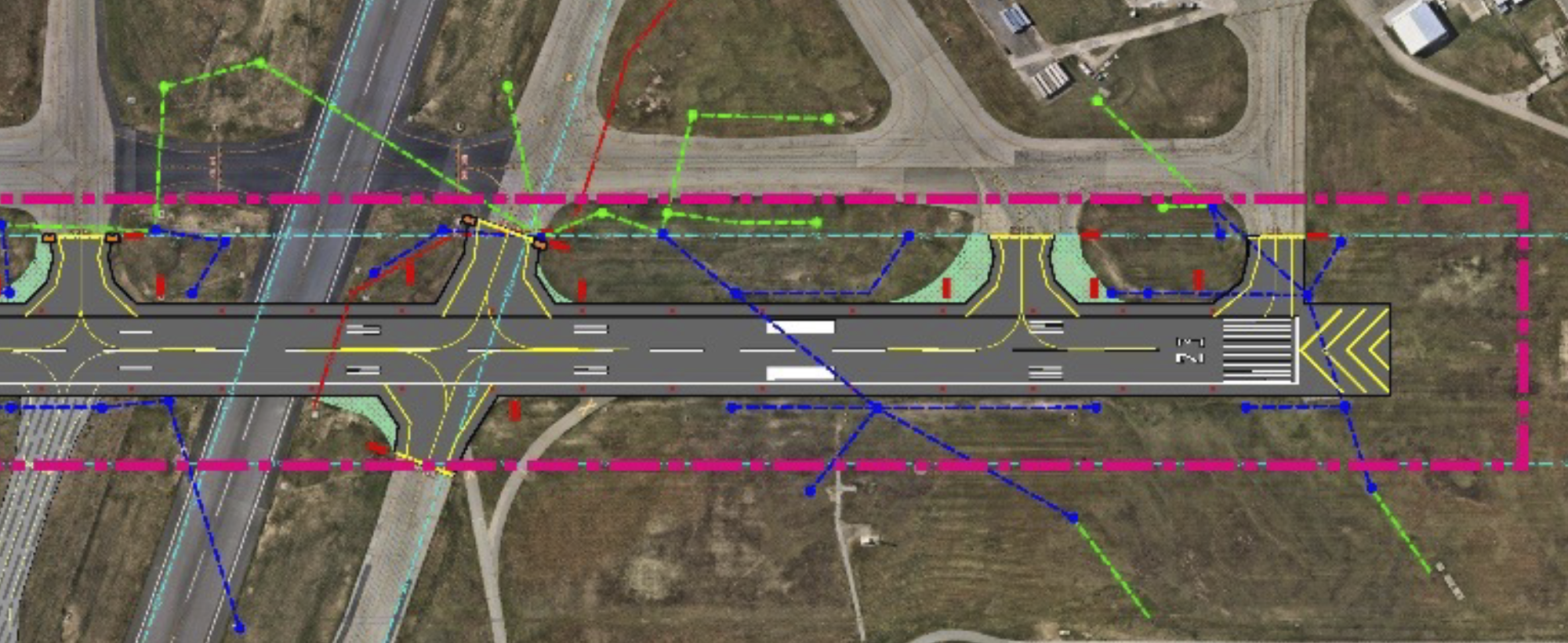
BSI utilizes both AutoCAD & Microstation drafting platforms with the industries latest software and technology in order to provide our clients with timely, accurate, and esthetical Subsurface Utility Engineering plans. BSI’s automated drawing process begins in the field with a detailed survey followed by a timely transfer of data to our CADD or Microstation systems.
BSI incorporates a guaranteed quality assurance process from field to finish that involves a thorough QA/QC review for each project prior to final delivery to our clientele. All SUE plans are prepared in conformance with ASCE/CI 38-22 “Standard Guideline for the Collection and Depiction of Existing Subsurface Utility Data”. This standard in part with BSI’s capability to adhere to any CAD standard provided by our clientele renders BSI as one of the SUE industry leaders in AutoCAD & Microstation plan production.


CCTV Inspection
BSI provides full color CCTV inspectional services for sanitary sewer and storm drain lines ranging in size from 3” or larger in diameter for up to 600 feet. BSI can also perform CCTV inspection for empty electrical and telecommunication conduits as small as 2” for a maximum length of 200 feet. Our equipment has the capability to input text and audio notations throughout the CCTV inspection and our reporting capabilities are state of the art in the industry. BSI utilizes high pressure sewer jetting equipment to properly clean any given sewer or drain system prior to CCTV inspection to maximize our inspection capabilities and to reduce the risk of blockages encountered.
In addition to recorded color video data, BSI can electronically designate the horizontal location of the CCTV camera head by means of a Sonde transmitter. This allows BSI’s field engineers to survey locate sewer, drain or empty conduit locations within the tolerances of Quality Level B information per CI/ASCE 38-02. BSI is able to provide CCTV inspectional data to our clients in virtually any video format the current market has to offer such as DVD, VCD, MPEG, WMV, and even VHS if so desired.
GIS Data Management
acility owners and Municipalities throughout the world have come to realize the power of GIS data management. Instead of a simple AutoCAD or Microstation electronic file, imagine that you could possess an interactive geo database that can store multiple levels of information in regards to utilities both above and below grade. Information such as age, condition, date installed, last replaced, wire type, pair count, etc. Even sewer/drain flow directions, inverts, and underground manholes/vaults can have survey data input in a manor that makes information queries simple and fast.
The use of Graphical Information Systems (GIS) will be the way of the future for all civil and environmental engineering disciplines. BSI realizes the importance of such systems and as a result we have incorporated GIS capabilities into our SUE and Civil engineering services for clients wanting only the most state-of-the-art data management capabilities. Please contact one of our experienced Project Managers to see if GIS Data Management is the right choice for your facility.
High Pressure Sewer Jetting
In order to properly assess the condition of sewer/drain lines, it is frequently necessary to clean the lines in question before a CCTV inspection is possible. BSI uses a high pressure water sewer jetting system to ensure proper cleaning before any visual inspection is conducted.
Nozzles are affixed to the end of a ½” diameter high pressure hose which is then snaked through sewer and drain lines to loosen debris and sediment within the pipe. Debris is then pulled downstream by retracting the pressure hose. If so desired, debris can be removed from the system at the manhole point of entry by vacuum extraction or allowed to flow downstream. BSI has the capacity to clean pipes from 4” to 36” in diameter. In addition, BSI is equipped with a detachable reel of hose ¼” in diameter and 200’ long, capable of operation up to 1500’ away from the system for hard to reach access points and building laterals.
Survey Services
The key component of BSI’s precise utility location services is the ability to capture all the information accurately by means of modern day survey technologies.
Equipment such as Electronic Total Stations and Data Collectors ensure BSI field crews can capture the results with precision, speed and accuracy. The results are downloaded into a CADD system (AutoCAD or Microstation) and processed by an experienced utility engineer.
In addition to survey services related to Subsurface Utility Engineering, BSI also provides topographic and construction layout survey services. Call and speak with one of our Project Managers today to discuss your project’s survey needs.
Traditional Test Pitting Services
In addition to non-destructive utility locating services, BSI also offers traditional test pitting services for your various project needs. Whether you are conducting soil analysis test pits, utility test pitting or condition assessment test pits, BSI is ready to assist with our fleet of Komatsu Mini-Excavators. Our mini excavators are designed for use in confined spaces with tight swing radius’ and a minimum working width of just under 5’ all without sacrificing stability or operating reach with a maximum digging depth of 9’.
Ultrasonic Condition Assessment
Ultrasonic pipe testing is a non-destructive procedure that introduces a high frequency sound wave into one exterior side of a material, and reflecting the sound wave from its interior surface to produce a precise measurement of wall thickness. The round trip duration of travel, divided by the known sound velocity through that particular material, provides a wall thickness measurement equally accurate to a micrometer reading. This process makes it easier to predict pending pipe failures.
As a non-destructive method, ultrasonic pipe testing offers obvious advantages over cutting out pipes for metallurgical inspection. It is non-intrusive, accurate, reliable, safe to both building and inspection personnel, provides immediate results, requires no system shutdown, and is extremely cost effective. BSI primarily utilizes ultrasound pipe testing for condition assessment of water and sewer force mains.
Please contact one of our experienced Project Managers to discuss whether Ultrasonic Condition Assessment techniques are the right choice for your next project.

Utility Tracing
Utility Tracing, also referred to as Quality Level B Utility Designation, is a systematic process of identifying and locating underground utilities using various electronic detection devices. Electromagnetic and radio-frequency locators such as hand held pipe locators, ground penetrating radar, and magnetic locators are the most commonly used technologies.
The majority of all utilities are designated using a transmitter to introduce a regulated frequency into a facility and the surface location painted or flagged using a walk over hand held detector. The resultant frequency detected on the surface is an approximate location and should be positively identified using non-mechanical excavation such as non-destructive vacuum excavation.
Please contact one of our experienced Project Managers to discuss how our Utility Designation Services can provide invaluable existing conditions data for your next project.
Non-Destructive Air Vacuum Excavation
Non-Destructive Air-Vacuum Excavation, also referred to as Quality Level A Utility Locating, is used to determine the exact horizontal and vertical location of an existing utility without the concern for causing damage to the target utility or adjacent utilities. This process involves removing the surface material over approximately a 1’x 1’ to 1’x 2’ area at the electronically designated location. The air-vacuum process utilizes compressed air jets that simultaneously loosen soil while the vacuum extracts the debris, until the target utility is exposed.
Non-Destructive Air-Vacuum Excavation can also be performed laterally through the surface opening, if necessary. It can be used at proposed boring locations to excavate below the “utility window” which is typically eight feet. This is useful when the mandated setback from existing utilities cannot be maintained or the location of the utilities is in question.
Please contact one of our experienced Project Managers to see whether vacuum excavation is the right choice for your project.
Our Clients






CONTACT US TODAY
Beneath every project runs BSI Expertise.
Nationwide leaders in precision Subsurface Utility Engineering.